

Montessori Animal Puzzle Board: Trace, Match & Spell
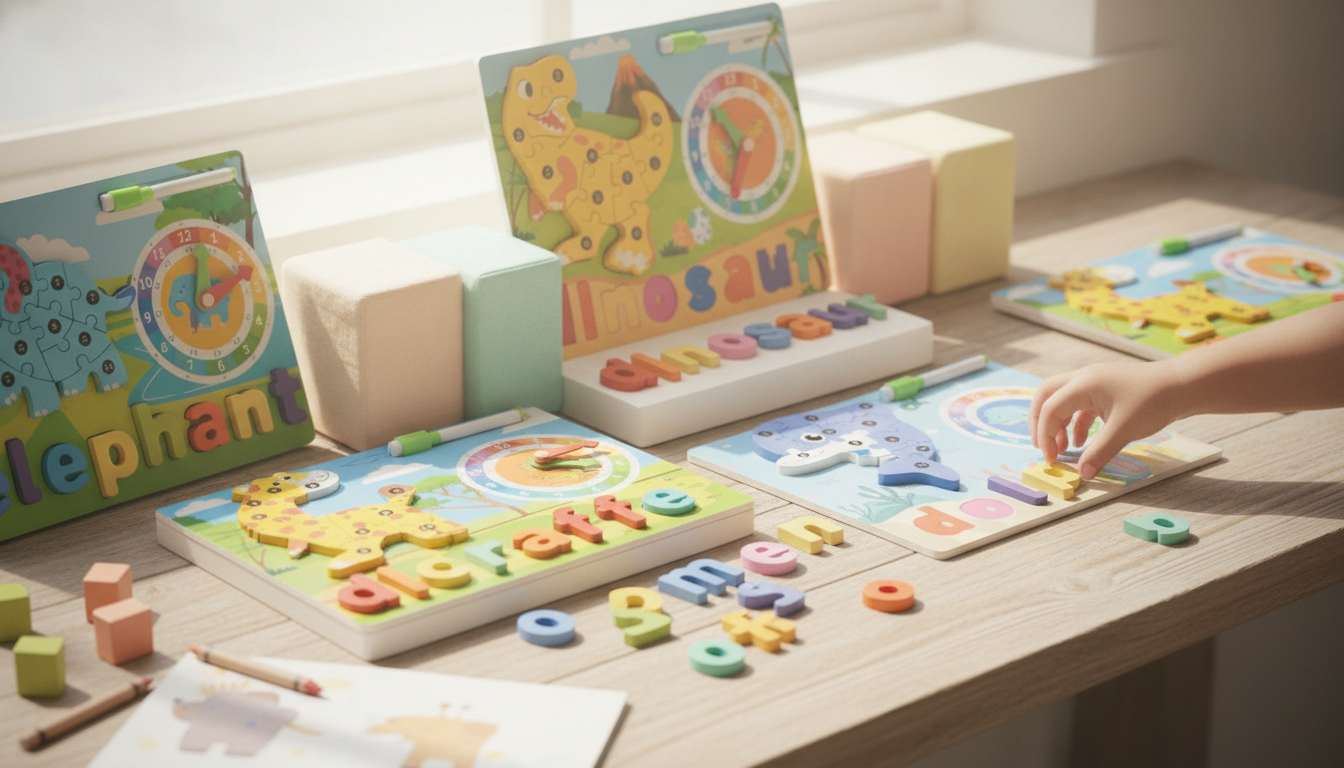
Montessori Wooden Animal Puzzle Drawing & Spelling Board
Hands-on work that blends matching, tracing, and early word play helps young children learn in a calm, natural way. A wooden animal puzzle drawing and spelling board supports fine-motor control, visual recognition, and early literacy through simple, repeatable activities that fit easily into short daily practice sessions. With one clear task at a time, children can build confidence, strengthen attention, and enjoy meaningful repetition without extra noise or flashing stimulation.
What This Board Is Designed to Teach
- Animal recognition through shape matching and picture-to-object association
- Pre-writing strength by tracing and controlled wrist movement during drawing activities
- Letter familiarity and early spelling through arranging or referencing letter forms on the board
- Focus and independence by completing a clear start-to-finish task without extra stimulation
- Language growth by naming animals, describing features, and repeating simple phonetic patterns
These skills connect closely to early developmental growth in communication and fine-motor abilities. If you like to compare your child’s progress with broad age expectations, the CDC developmental milestones are a helpful reference point.
Key Features to Look For in a Wooden Learning Board
- Smooth, child-safe finish with rounded corners and no sharp edges
- Clear, high-contrast illustrations that match the puzzle pieces accurately
- Pieces sized for small hands to grasp and rotate without frustration
- A repeatable drawing surface that wipes clean easily (or a dedicated space for ongoing practice)
- Durable wooden construction that resists warping and splintering with regular use
A well-designed board makes the “control of error” obvious: the piece fits (or it doesn’t), and the child can self-correct with minimal adult input. That independence aligns with developmentally appropriate practice supported by the National Association for the Education of Young Children (NAEYC).
Skill-Building Activities (Fast, Repeatable, Low Prep)
Choose one objective per session and keep it short—often 5–10 minutes is plenty. This supports positive engagement and keeps learning playful, which the American Academy of Pediatrics highlights as essential for healthy child development.
- Match-and-name: Place each animal piece, then say the animal name and one describing word (big, fast, striped).
- Trace-and-draw: Trace the animal outline (if present) and add one detail each round (tail, spots, ears).
- Sound-start game: Say the first sound of the animal name and find the matching animal piece.
- Spelling practice: Build the animal name (or a shortened version) and read it aloud slowly.
- Memory mix-up: Remove 2–4 pieces, mix, and rebuild while naming each animal.
Keep it calm and consistent
When a child repeats the same sequence daily, the “work” becomes familiar and satisfying. Demonstrate once at a slow pace, then step back. If help is needed, offer the smallest hint possible (for example, turning a piece slightly rather than placing it for them).
Age Range and Developmental Fit
- Toddlers: Focus on matching, naming, and simple vocabulary; keep sessions short and upbeat.
- Preschoolers: Add tracing, simple phonics (first sound), and guided spelling support.
- Early readers: Practice decoding animal words, sounding out letters, and independent completion.
- For mixed ages: Offer the same board with different difficulty—naming for younger children, spelling challenges for older ones.
A simple way to adapt on the spot: for younger children, ask for one word (“lion”). For older children, ask for a phrase or sentence (“The lion is big.”) or a slower sound-out (“/l/ /ī/ /ən/”).
Safety, Materials, and Care
- Supervise younger children, especially if pieces are small enough to pose a choking risk.
- Choose non-toxic materials and finishes when possible; avoid strong chemical odors.
- Wipe with a lightly damp cloth; avoid soaking wood and avoid harsh cleaners.
- Store pieces together in a bag or small box to prevent loss and to keep the activity set complete.
- Inspect periodically for cracks, splinters, or loosening parts; replace if damaged.
Quick Setup Guide for a Montessori-Style Shelf
Learning Progress Tracker
| Skill Area | Starter Activity | What to Watch For | Easy Next Step |
|---|---|---|---|
| Matching | Place 4–6 pieces correctly | Rotates pieces to fit; fewer trial-and-error attempts | Increase to full set or add a timed clean-up challenge |
| Vocabulary | Name each animal | Uses clear words; adds descriptors (color/size) | Ask for a short sentence about each animal |
| Fine-Motor | Trace or draw one animal | Improved pencil grip; smoother lines; less pressure | Add one new detail per repetition |
| Early Spelling | Build the animal name with letters | Recognizes letters; says sounds; correct order | Move from copying to sounding out with hints |
Product Options
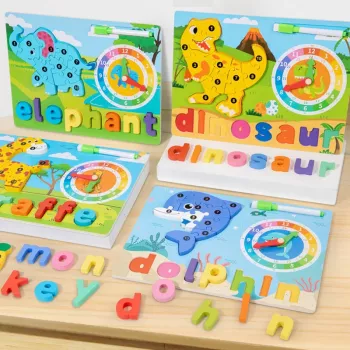
- Montessori Wooden Animal Puzzle Drawing & Spelling Board: a compact, budget-friendly choice for matching, drawing practice, and early spelling routines. Works well as a short daily station (5–10 minutes) to build consistency without screen time.
- Baby Mobile Phone Decompression Toy & Pure Cotton Towel Set: a helpful addition for calm sensory play and simple routines, especially for younger siblings who want their “own work” nearby while an older child uses the board.
FAQ
What age is a wooden animal puzzle drawing and spelling board best for?
Toddlers often do best with matching and naming, preschoolers can add tracing and first sounds, and early readers can use the board for decoding and simple spelling. Supervise closely if any pieces could be a choking hazard, and adjust the challenge so it stays achievable.
How can this board support early reading without turning it into a drill?
Keep sessions short and playful: try first-sound games, slow blending, and “copy first, then try alone” spelling. Stop before fatigue so the activity remains positive and the child wants to repeat it.
How should a wooden learning board be cleaned and stored?
Wipe it with a lightly damp cloth, avoid soaking the wood or using harsh cleaners, and let it dry fully. Store all pieces together in a small bag or box so the set stays complete and ready to use.














Leave a comment